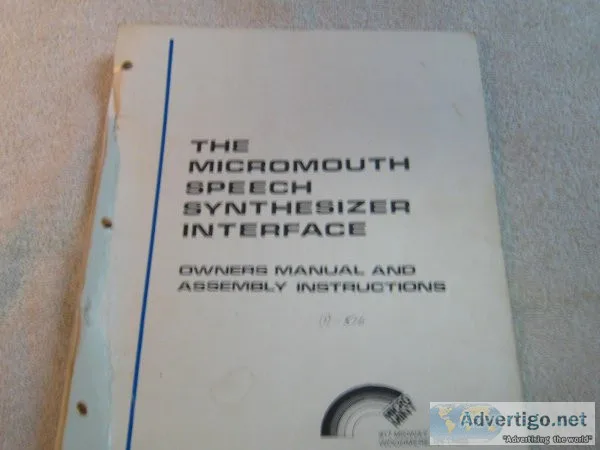
THE MICROMOUTH SPEECH SYNTHESIZED INTERFACE
For the Radio Shack TRS-80 model 1. 1981. Also works with the Apple II Local pick-up preferred (but will ship eat the buyer s expense. Note This is a one-of kind original The full schematic is in the manual Kingston Micromouth Speech Synthesizer Inter Note The manual is quite detailed including parts list and schematic images The listing was over 30 000 words in length so it exceed the number of words permitted by Craigslist The history of the TRS-80 Model 1 s en.Wikipedia.org wiki TRS-80 Note the grammar and punctuation in this publication leaves a lot to be desired. Before computers with spellcheck a document had to be proofread by several people. This one obviously wasn t. While you are perusing this document keep that in mind Local pick-up preferred (please call first) but will ship at the buyer s expense. Illustrated Kingston Classified Ads - Books 15 IMG_8307 Illustrated Connector Pin-out Information Schematics Digitalker Speech Processor Interface Parts List Apple II Computer Slot Addresses Basic Computer Language Program Information Introduction Advances in the production of high density LSI chips and new techniques to synthesize speech have reduced the cost of voice output systems an order of magnitude. Attaching a speech synthesizer to your computer is now a reasonable as adding and other peripheral. The dividing line in cost is primarily the number of words that the synthesizer can speak. Limited vocabulary synthesizers such as the TMS 0280 in the Texas Instruments Speak-and-Spell or any others that have their vocabulary stored totally in ROM are generally less expensive. Speech interfaces using phoneme synthesizers such as the VOTRAX usually require the help of a computer program to generate extended voice output The Micromouth is one of the more cost effective limited vocabulary voice synthesizers. It uses the new DIGI-TALKER dt1050 chip set from National Semiconductor which has a stored vocabulary of 144 expressions. Using this interface it is possible to add voice output to monitoring functions computer games and calculations. It can say THE TIME IS 6 40 PM and NUMBER 4 IS SET AT 6.35 VOLTS just as easily as CONTROL ERROR or DANGER A STAR IS ON THE LEFT AT 1000 METERS . The Digi-Talker Micromouth board is plug compatible with the APPLE II and the TRS-80 Model I computers. It is buss compatible with other computers such as Digital Group or Heath H8 and can be connected to any computer with an 8 bit parallel port (such as a printer port. It requires no software beyond a simple BASIC statement to say and expression in the vocabulary list. For example OUT 127 120 (or POKE -16001 120 in the Apple II) will say PLEASE . The designs and attributes of the Micromouth Speech Processor Board will be discusses in detail later. First a little background on speech synthesis techniques in general and then the Digi-Talker in particular. Speech Synthesis Techniques There are three major techniques presently employed to synthesize the human voice They are format synthesis linear predictive coding (LPC) and waveform digitation. The differences between them are primarily the numbers of bits per second of data required to construct a word. Format synthesis is essentially a modeling of the natural resonances of the vocal tract. The bands of resonant frequencies defined are called formants. In an electronic synthesizer these frequencies are generated by excitation sources passing through filters. One form of the formant technique is called phoneme synthesis in which the spectral parameters are derived from basic word sounds. In such a circuit each phoneme is given a code and the synthesizer module (or chip) utters the phoneme sound corresponding to the code when it is activated. Creation of speech therefore is simply a matter of stringing the phoneme codes together. In most cases the electronic voice generated is quite intelligible but may have a mechanical or non human quality about it. Continuous speech using phoneme synthesis can generally be accomplished with less that 400 bits second data rate. This technique is used by the Votrax Division of the Federal Screw Works in their SC-01 Speech Synthesizer Chip and other products. Linear-predictive coding is very similar to formant synthesis. Both are based on the frequency domain and use similar hardware to model the vocal tract. Rather than a simple phoneme code however the stored LPC parameters are filter coefficients gains and excitation frequencies. LPC refers to the programmed activities of the multistage lattice filters that produce the desired formants. Quality speech can generally be achieved with data rates of 1200-2400 bits second. This synthesis technique is used by the Speak-and-Spell and the TI 99 4 Text to Speech Translator. It is also used in the General Instruments VSM 2032 Voice Synthesis Module. The third method is waveform digitization. This is very old technique produces speech by generating a waveform with the amplitude characteristics of voice in contrast to parameter encoding methods which represent speech in terms of frequency. The simplest form is uncompressed digital data recording called pulse-code modulation. In digital recording the analog speech waveform is sampled at twice the frequency of the highest voice component and converted to digital format through an analog to digital converter. Once stored the digital signal can be played back through a digital to analog converter and low-pass filter. One major advantage of digitally encoded speech is its human quality. Since it is in essence a recorded a recorded voice the reproduced speech retains the inflections and accents of the original voice. It is not only possible to have a speech with male and female voices but one with Japanese or Midwestern accents. The clarity of the reproduction depends on the speech compression method used. Unfortunately one problem in using PCM alone is tghat it requires very high data rates. 100KBits second are not unusual with this method. To reduce the data rate it is necessary to compress the speech data. One compression method is called delta modulation. As in PCM the analog speech waveform is sampled but this time only the changes in amplitude between the samples are stored. Since speech contains many redundant sounds and silences these changes are much less than th absolute amplitude of the waveform. Delta modulation therefore reduces the amount of memory required to store a library of words. Ultimately the total memory required for continuous speech becomes a function of exotic compression algorithms. Data rates as low as 2400 bit sec have been achieved. The National Semiconductor Digi-Talker DT-1050 speech synthesis chip set uses data compressed digitized speech. Digi-Talker The Micromouth synthesized speech board is based upon the National Semiconductor DT-1050 speech-synthesizer chip set.. The chip set consists of a speech processor (SPC) and two 64 Kbit ROMS. The speech processor uses PCH encoding with a comprehensive data compression algorithm developed by Forest Mozer at the University of California. The primary compression method employed is delta modulation. As previously described this concept recognizes that speech is generally smooth and continuous. Rather than storing the absolute amplitude of the voice signal (remember analog values are stored as digital numbers the larger the voltage the more bits are necessary to represent it) the difference between successive samples are stored instead. During speech reconstruction successive amplitudes in the output waveform are obtained by adding the difference (delta value) to the previous value. The speech processor also uses phase-angle adjustment and half-period zeroing compression techniques. Phase-angle adjustment is based on the concept that the intelligibility of speech is not determined by the phase angle of its Fourier components. Therefore these values can be adjusted to produce a waveform with mirror symmetry. Being symmetrical the redundant data need not be stored twice. In half-period zeroing the low amplitude portion of a signal is reproduced as silence. For the most part only the center half of any pitch period needs to be stored since the center half of any pitch period needs to be stored since the center half contains most of the amplitude. The remainder of the waveform contains relatively little of significance and can be reduced to silence. The 144 expression Digi-Talker vocabulary was initially recorded through a microphone the differentiated and digitized. A computer program was applied to this data to perform phase-angle adjustment delta-modulation and half-period zeroing. The redundant pitch periods and phonemes were reduced to individually stored periods and number of times they are repeated (usually 3 to 8). The resulting data containing frequency amplitude and contained in the control information is stored in the 128 Kbit (2 X 64K) speech ROMS. Each block of speech data contains a control word specifying the ROM location of an expression the type of waveform to be generated and the number of times to repeat it. Speech data from the ROM is loaded into the SPC s data register and passed on to the delta-modulator decoder. This results is a 4 bit number that is applied to the D A. Successive and regressive digitization s produce a final waveform that is generated in real time. The Micromouth Hardware In general saying any of the 144 stored expressions is done just by loading a word code into the SPC. The code (selected from the enclosed list) is latched when the write enable and chip select lines are strobbed. The SPC immediately commences speaking the addressed expression. If the input code is 0 corresponding to THIS IS DIGI-TALKER it takes approximately 1.3 seconds to say a word like AT takes much less time. If another word address is strobed into the SPC while it is speaking it will terminate the current output and begin the new expression. To keep from jamming one word on top of another a handshaking signal (INTR) goes to a logic low when the SPC is talking. The Micromouth board is designed to be signal compatible with a number of computers or exercised thought a parallel I O port. Connector J1 is plug compatible with the Apple II and connector J2 is compatible with the TRS-80 Model I. The Micromouth board is designed to accommodate bidirectional as well as unidirectional busses. The data bus is normally attached to pins 8 thru 15 of IC1. The busy line from the SPC is attached INTR is jumpered (either JP4 or JP5) to accommodate the particular bus being used. For TRS-80 and Apple II which both have bidirectional data busses inserted to connect the INTR output to the D0 bus line. During an input command intended the status of this line only the least significant bit (LSB) will be affected. For a unidirectional bus such as a Digital Group computer JP4 would be inserted and IC6 pin 5 connected to the LSB of the input bus. Detailed connection instructions will be given later. ICs 4 5 and 6 perform addresses decoding and chip selection. The port address of the board is set by inserting JP1 or JP2. With JP1 installed the address is port 7F hex (127 decimal). With JP2 installed it is port FF hex (255 decimal). On the Apple II the address depends upon the slot in which the board is inserted. An address map for the Micromouth Speech Processor board installed in an Apple II is provided. The Speech Processor chip requires 7 to 11 volts fo normal operation while the ROMs and other ICs only require 5 volts. To accommodate the different ranges two separate voltage regulators are used. IC9 can safely accommodate an input range of 12 to 24 volts. When installed in an Apple II it receives 12 volts from the bus. On the TRS-80 a separate 22 VCT power transformer supplies approximately 15 VRMS. IC9 and Z1 regulate the input to the SPC to about 9 volts. IC10 in turn reduces this to the 5 volts required by the rest of the components.. The typical current requirements of the Micromouth Speech Processor Board circuitry is about 250ma. Most of this is consumed by the two 64 Kbit ROMs which are used a few microseconds at a time. A memory enable signal ROMEM is used with transistor (Q1) to gate the power on and off to the ROMs. The average current required ends up being about 80mA. The final interface section is the filter and amplifier ICs 7 and 8. As in any digitized speech output a low pass filter is requires. For low pitched male voices the cutoff frequency should be about 100 Hz for a high pitched female or children s voices it should be 300Hz. The filter on the Micromouth board has a cutoff frequency around 150 Hz. The frequency resp
-
Price: 100 USD
Category: Books
Important!
There are a lot of advertisers on Advertigo. We cannot check them one by one.
You work hard for your money and you want a company you can rely on when you are buying or selling things. That's why we want to help you protect yourself from fraud. In this section, you'll find informative tips and other useful material to stay informed and help reduce your chances of falling victim to scammers.
Please understand that Advertigo.net is a free service to help buyers and sellers (and etc.) find one another. Advertigo.net is not involved in any transactions and can not police the actions of our many users.
Useful links
Similar ads
Accurate latex typesetting for academic technical content
Alpha eBook provides LaTeX typesetting services for content where equations, notation, references, tables, and structured
Alpha Ebook

Messianic prophecies cross examined
Author Loujan Jubin Matin expresses his sincere hope that his work, while primarily intended for
Author Loujan Jubin Matin

Affordable kindle conversions for accurate digital book
Looking to digitize your manu for Amazon Kindle? Alpha eBook offers expert Kindle conversions that
Alphaebook
Reflowable epub conversion for high-quality responsive ebooks
Alpha eBook delivers professional reflowable ePUB conversion to help authors and publishers create flexible, device-responsive
Alphaebook
 4 USD
4 USD
3333 Years King Tut novel by Joel Goulet
King Tut slept undisturbed in his tomb for more than three thousand three hundred years...
Joel Goulet
 15 USD
Radio Shack &ndash NATIONAL TTL DATA BOOK © 1976
Local pick-up preferred (please call first). but will ship at the buyer s expenseKingston Books
Howard Walker
 10 USD
World Satellite TV and Scrambling Methods &ndash The Technicians
Local pick-up preferred (please call first) but will ship at the buyer s expense.Kingston Books
Howard Walker
 45 USD
 50 USD
Russian Books
Assortment of Russian paperbacks and hardcovers. Contemporary and classics.Used. Some good condition some new.Pick up
Polina Bk
 50 USD
CONFIDENTIAL REPORT Produced by The Business Research Division o
Local pick-up preferred (pleas call first) but will ship at the buyer s expenseIllustrated Sample
Howard Walker