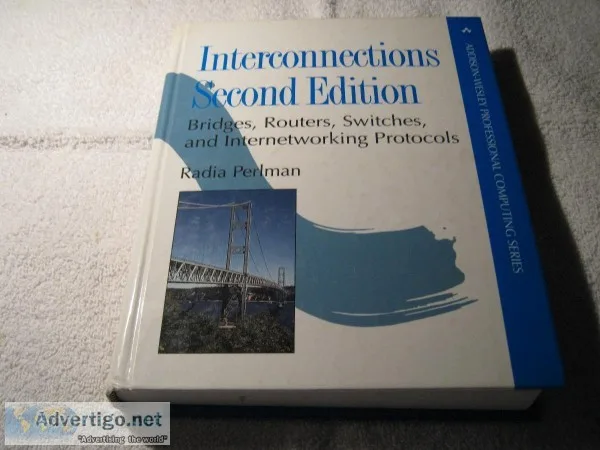
NEW Interconnecting 2nd Edition. Bridges Routers Switches and
Local pick-up preferred but will ship at the buyer s expense.Kingston Books 14 IMG_5232Author Radia PerlmanPublisher Addison Wesley 55.00 on AmazonContents (in Brief)Preface ..xiChapter 1. Essential Networking Concepts ..1Chapter 2. Data Link Layer Issues ..19Chapter 3. Transport Bridges ..45Chapter 4. Source Routing Bridges ..95Chapter 5. Hubs Switches Virtual LANs and Fast Ethernet ..127Chapter 6. Network Interface Service Models ..145Chapter 7. Connection-oriented Nets X..25 and ATM ..153Chapter 8. Generic Connectionless Service ..179Chapter 9. Network Layer Addresses ..189Chapter 10. Connectionless Date Packet Formats ..221Chapter 11. Neighbor Greeting and Autoconfiguration ..265Chapter 12. Routing Algorithm Concepts ..299Chapter 13. Fast Packet Forwarding ..347Chapter 14. Specific Routing Protocols ..367Chapter 15. WAN Multicast ..449Chapter 16. Sabotage-proof Routing ..479Chapter 17. To Route Bridge or Switch Is That the Question .....493Chapter 18. Protocol Design Folklore ..503Glossary ..523Index ..533This latest release of Interconnections is a competent update of a networking classic. Radia Perlman explains hundreds of details about getting computers--and computer networks--to talk to one another smoothly accurately and efficiently. Perlman inventor of the spanning-tree bridging algorithm covers the Open Systems Interconnect (OSI) reference model bridges switches hubs Virtual Local Area Networks (VLANs) plus connection-based and connectionless networks. She also does a great job of explaining the underpinnings of internetworking protocols including packet format addressing routing (both generically and in terms of RIP RTMP OSPF and other protocols) and security. There s plenty of IPv6 information here mostly from a theoretical vantage point.The best parts of Perlman s approach to her subject are the little thought experiments that explain why various aspects of internetworking behave the way they do. For example Perlman talks about Maximum Transmission Unit (MTU) discovery by presenting four different hypotheses for figuring out MTU. For each possible solution she discusses strengths weaknesses and real-life considerations. She applies this method to dozens of other problems and phenomena making Interconnections a very close approximation of learning by experiment. --David WallTopics covered Open Systems Interconnect (OSI) reference model bridges switches hubs Virtual Local Area Networks (VLANs) and internetworking protocols.Interconnections Second Edition is about what goes on inside the boxes that move data around the Internet. These boxes are variously called bridges routers switches and hubs. The book also describes the devices that connect to the network.There is considerable confusion in this area. Most of the terminology is ill defined and is used in conflicting ways. The terminology and the specifications tend to be daunting. Some knowledge is spread among many different documents much is unwritten folk wisdom. Adding to the confusion is dogma. Beliefs are accepted as truth and questioning any of the dogma is often greeted with hostility. But good engineering demands that we understand what we re doing and why keep an open mind and learn from experience.From Radia Perlman In Interconnections Second Edition instead of diving right into the details of one protocol I first focus on the problems to be solved. I examine various solutions to each of these problems and discuss the engineering trade-offs involved. Then I look at a variety of solutions that have been deployed and compare the approaches. I give technical arguments for any opinions and if you think I have missed any arguments I welcome email discussion. My email address is at the back of the book which I hope you will find after having read the book cover to cover.In the first edition my intention was to help people understand the problems and the general types of solutions assuming that they would read the specifications to get the details of specific protocols. But people used the book as a reference in addition to using it to understand the issues. So in this edition I have documented many more of the protocols in detail.I believe that to understand something deeply you need to compare it to something else. The first edition was minimalist in that I always used only two examples two types of bridges bridges versus routers connection-oriented versus connectionless network layer protocols and two examples of connectionless protocols (CLNP and IP). In this edition I add a lot more examples including ATM IPv6 IPX AppleTalk and DECnet. I did this in part because these protocols exist and it is hard to get information about them. But mostly I did it because the protocols embody interesting ideas that should not be lost. When we design new protocols we should learn from previous ideas both good and bad. Also it takes very little additional effort after the problem is described generically to describe several examples. Roadmap to the BookThe first four chapters are not significantly different from their counterparts in the first edition but the rest of the book has been largely rewritten. Chapters 1 through 4 cover general networking concepts data link issues such as addressing and multiplexing transparent bridges and the spanning tree algorithm and source routing bridges. Chapter 5 is completely new and explains how the notion of a switch evolved into a rediscovery of the bridge. It also covers VLANs and fast Ethernet.The remainder of the book concentrates on layer 3 (the network layer). Chapter 6 gives an overview of the network layer. Chapter 7 covers connection-oriented networks including ATM and X.25. Chapter 8 discusses the issues in a generic connectionless network layer. Chapter 9 covers layer 3 addressing generically and gives a detailed comparison of IP IPv6 CLNP DECnet AppleTalk and IPX. Chapter 10 covers the information that should appear in a network layer header and contrasts the headers of several protocols.Chapter 11 covers autoconfiguration and neighbor discovery including protocols such as ARP and DHCP. Chapter 12 covers routing algorithms generically.Chapter 13 discusses the problem of doing longest-prefix matching which is required in order to forward IP packets quickly. Chapter 14 discusses the specifics of various routing protocols including RIP IS-IS OSPF PNNI NLSP and BGP. Chapter 15 covers network layer multicast. Chapter 16 explains how to design a network that is invulnerable to sabotage an idea whose time may come.The final two chapters summarize the book and I hope they will be mostly light and entertaining reading. Chapter 17 probes the mystery of what if anything distinguishes a router from a bridge. Chapter 18 attempts to capture folk wisdom about how to design a protocol.Finally there is an extensive glossary. I try to define terms when I first use them but if I ever fail to do that you will probably find them in the glossary. AcknowledgmentsWriting this section is scary because I am afraid I will leave people out. I d like to thank the people who reviewed all or part of the book Peter Memishian Paul Koning Tony Lauck Craig Partridge Dan Pitt Brian Kernighan Paul Bottorff Joel Halpern Charlie Kaufman Mike Speciner Andy Tanenbaum Phil Rosenzweig Dan Senie William Welch Craig Labovitz Chase Bailey George Varghese and Suchi Raman. Other people who have been helpful by answering questions are Ariel Hendel Rich Kubota Stuart Cheshire Tom Maufer Steve Deering and John Moy. The first time I sent an email question in the middle of the night (when I did most of my work on this book) to Craig Partridge the co-series editor for this book the beep indicating incoming mail happened so immediately that I assumed it was an automatic mail responder informing me he was on vacation. But it was an answer to my question. I assume he doesn t have an automatic mail responder so clever that it can answer technical questions so I thank him for being so prompt and available. Brian Kernighan the other series editor also had detailed and helpful comments on the entire book.The people at Addison-Wesley have been amazingly patient with me for the many years in which I ve been working on this edition. I m not sure they had any alternative besides patience but it was nice that they believed I d finish even when I wasn t so sure. So thank you to Mary Hart Karen Gettman Jacquelyn Doucette and Jason Jones. And I d also like to thank my copy editor Betsy Hardinger. She of all people will have read every word of the book while maintaining the concentration to note inconsistencies and ways of removing excess words here and there. I know it s her job but I m still impressed.Mike Speciner helped me figure out the mysteries of Framemaker. Ray Perlner made sure that I maintained some humor in the book and watched over my shoulder while I typed the last chapter to see that I had enough funny bad real-life protocols. Dawn Perlner has been terrifically supportive convincing her friends and even strangers in bookstores to buy my books.Hardcover 537 pages ISBN 0-201-63448-1
-
Price: 30 USD
Category: Books
Important!
There are a lot of advertisers on Advertigo. We cannot check them one by one.
You work hard for your money and you want a company you can rely on when you are buying or selling things. That's why we want to help you protect yourself from fraud. In this section, you'll find informative tips and other useful material to stay informed and help reduce your chances of falling victim to scammers.
Please understand that Advertigo.net is a free service to help buyers and sellers (and etc.) find one another. Advertigo.net is not involved in any transactions and can not police the actions of our many users.
Useful links
Similar ads
Accurate latex typesetting for academic technical content
Alpha eBook provides LaTeX typesetting services for content where equations, notation, references, tables, and structured
Alpha Ebook

Messianic prophecies cross examined
Author Loujan Jubin Matin expresses his sincere hope that his work, while primarily intended for
Author Loujan Jubin Matin

Affordable kindle conversions for accurate digital book
Looking to digitize your manu for Amazon Kindle? Alpha eBook offers expert Kindle conversions that
Alphaebook
Reflowable epub conversion for high-quality responsive ebooks
Alpha eBook delivers professional reflowable ePUB conversion to help authors and publishers create flexible, device-responsive
Alphaebook
 4 USD
4 USD
3333 Years King Tut novel by Joel Goulet
King Tut slept undisturbed in his tomb for more than three thousand three hundred years...
Joel Goulet
 15 USD
Radio Shack &ndash NATIONAL TTL DATA BOOK © 1976
Local pick-up preferred (please call first). but will ship at the buyer s expenseKingston Books
Howard Walker
 10 USD
World Satellite TV and Scrambling Methods &ndash The Technicians
Local pick-up preferred (please call first) but will ship at the buyer s expense.Kingston Books
Howard Walker
 45 USD
 50 USD
Russian Books
Assortment of Russian paperbacks and hardcovers. Contemporary and classics.Used. Some good condition some new.Pick up
Polina Bk
 50 USD
CONFIDENTIAL REPORT Produced by The Business Research Division o
Local pick-up preferred (pleas call first) but will ship at the buyer s expenseIllustrated Sample
Howard Walker